
Wine Regions
A red wine with white grapes fermented into it sounds like a mistake. In the northern Rhône it is long-standing practice. Here is where the blend came from, how Shiraz Viognier in South Australia and Canberra got its start, and what the research says it does.
Côte-Rôtie, the roasted slope
Côte-Rôtie sits on the west bank of the Rhône near Ampuis, just south of Vienne. The name means “roasted slope”, after the long hours of sun on vineyards that approach 60 degrees of incline. Only Syrah and Viognier are permitted. The rules allow up to 20 per cent Viognier, and the two grapes must be fermented together.
Côte Brune and Côte Blonde
The appellation has two sides. Côte Brune has dark, iron-rich schist and firmer, longer-lived wines. Côte Blonde has paler granite and schist and more elegant wines. Marcel Guigal’s single-vineyard bottlings, including La Mouline and La Landonne, made the region famous.
How it tastes
Classic Côte-Rôtie shows green olive, raspberry, violets and smoked meat, with black pepper, blueberry and leather. The violet and floral lift is what Viognier is meant to add.
The grape that nearly disappeared
Viognier came close to extinction. In neighbouring Condrieu, its home appellation, fewer than 12 hectares were planted in the 1960s. Steep hillsides and weak demand made it hard to justify. Plantings recovered to 135 hectares by 2005.
Shiraz Viognier in South Australia and Canberra
Yalumba and the Eden Valley
The first commercial Viognier in Australia was planted by Yalumba in the Eden Valley in 1980. The vines traced back to three cuttings that arrived from Montpellier in 1968 and were grown at the Nuriootpa Research Station.
Getting it right took time. Chief winemaker Louisa Rose joined Yalumba in 1992 and first treated Viognier like Riesling, picking early and fermenting cool. The wines lacked flavour. From the mid-1990s she let the grapes ripen further, picking around the same time as Shiraz, and the results improved.
Clonakilla and the blend
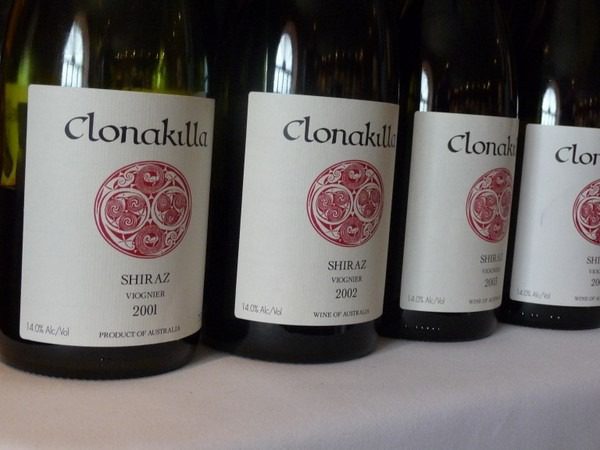
The blend made its name in Murrumbateman, north of Canberra. Tim Kirk of Clonakilla visited the Rhône in 1991 and made his first Shiraz Viognier in 1992, modelled on Guigal’s wines. He keeps the Viognier low. The 2001 vintage used 7 per cent, and Decanter has since named it a Wine Legend. Writer Max Allen called it “a serious rival for the classiest Côte-Rôtie”.
What co-fermentation does
The usual explanation is colour: Viognier is said to help Syrah’s pigments bind and hold. A 2012 study in the American Journal of Enology and Viticulture tested this. Casassa and colleagues co-fermented Syrah with 5, 10 and 20 per cent Viognier.
The 10 and 20 per cent additions lowered most colour measures. After 580 days in bottle, tannin levels were the same across the wines, and the 5 per cent wine looked like straight Syrah. The authors found the additions improved neither phenolic make-up nor colour stability.
The case for Viognier rests on aroma. It is a perfumed white grape, used in small amounts for lift, which is why careful makers keep it to a few per cent.
Taste the Rhône in Adelaide
Ask the team what Rhône-style reds are open by the glass, and see the menu for the cheese to go with them. For the wider French picture, read our French wine guide. To test your palate against other tasters, join the SA Wine Options League on Monday 5 October, $40.
Sources
Come and taste it
Bar Septimus pours French and Australian wine by the glass alongside artisan cheese and charcuterie at 220 Grenfell Street, Adelaide East End.