
How to build a wine cellar: buy so that something is ready to open every year, not everything at once.
Wine Science
Most cellars go wrong in one of two ways. Everything comes ready at once, or nothing is ready when you want a bottle. This is the method we use to avoid both, and the thinking behind The Cellar Collection.
Start with the space
A cellar is counted in bottles, but what it holds is time. At three bottles a week, a six-bottle benchtop fridge holds a fortnight of wine. A 180-bottle cabinet holds a little over a year. A 1,500-bottle cellar holds close to ten.
That number sets how far ahead you can buy. There is little point laying down a Barolo for 2040 in a fridge that empties every month, and just as little in filling a room-sized cellar with wine that needs drinking this summer.
The space also sets how long wine can safely stay. A thermoelectric benchtop unit keeps wine at serving temperature and struggles once the kitchen passes 30°C. A compressor fridge with humidity control, or a cellar held at 13 to 16°C and 50 to 80% humidity, will keep wine for decades if the door stays shut and nothing shakes it.
To see how many bottles your own space will hold, try our wine cellar calculator. Put in the room size and racking for each wall, and it draws the floor plan and estimates the cooling and floor load as well.
Give every bottle a year
Every wine we choose gets three dates: the year it opens up, the year it is at its best, and the year it should be gone. We then sort it into one of four drinking windows by its best year.
| Window | Best year to open | What sits here |
|---|---|---|
| Drink Now | 2026 to 2027 | Non-vintage sparkling, rosé, aromatic whites, Beaujolais, young Pinot and Grenache, mature back vintages |
| Drink Soon | 2028 to 2031 | Non-vintage Champagne, good Chardonnay, regional Shiraz and Cabernet, Langhe Nebbiolo, village Burgundy |
| Drink Later | 2032 to 2036 | Vintage Champagne, premier cru Burgundy, Barbaresco, Coonawarra and Margaret River Cabernet, Clare and Eden Valley Riesling |
| Drink a Lot Later | 2037 on | Barolo, classed-growth Bordeaux, grand cru Burgundy, top Shiraz and Cabernet, Sauternes, vintage Port, German Spätlese |
How we set the year
We start with the kind of wine. We work from 67 ageing profiles, from premier cru Burgundy to Clare Riesling to regional Shiraz, each with a typical peak counted in years from vintage. Good Barolo peaks somewhere between eight and 25 years. A regional Shiraz is at its best between two and ten.
Then we adjust for quality. Within any style, the better wine lasts longer. A $20 Shiraz peaks early; a $120 one from a great site holds its line for years. We stretch or shorten each profile to suit.
Last, the vintage tells us how far along the wine already is. Anything past its drink-by is left out.
We ran this across the 2,677 wines on our two supplier lists. 1,236 landed in Drink Now, 694 in Drink Soon, 350 in Drink Later and 397 in Drink a Lot Later. The price pattern is hard to miss.
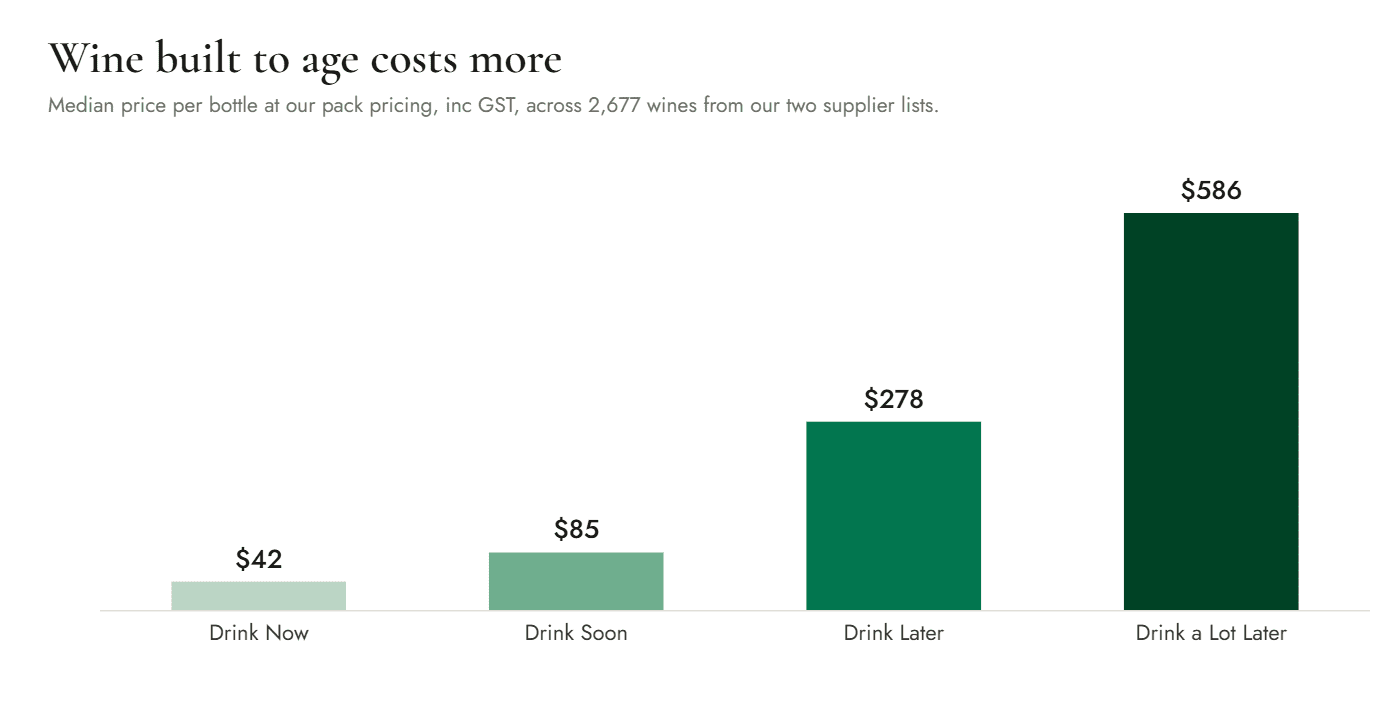
Wine that will improve for fifteen years comes from better fruit, is made in smaller volumes and is often held back by the producer before release. It costs more, and that shapes the rest of the method.
Build a ladder
The aim is a cellar where bottles come ready at about the rate you drink them. Think of it as a ladder: some wine for now, some for the next few years, some for the next decade.
The bigger the space, the higher the ladder reaches. A benchtop fridge is two-thirds Drink Now. A 1,500-bottle cellar puts 69% of its bottles into the two long windows.
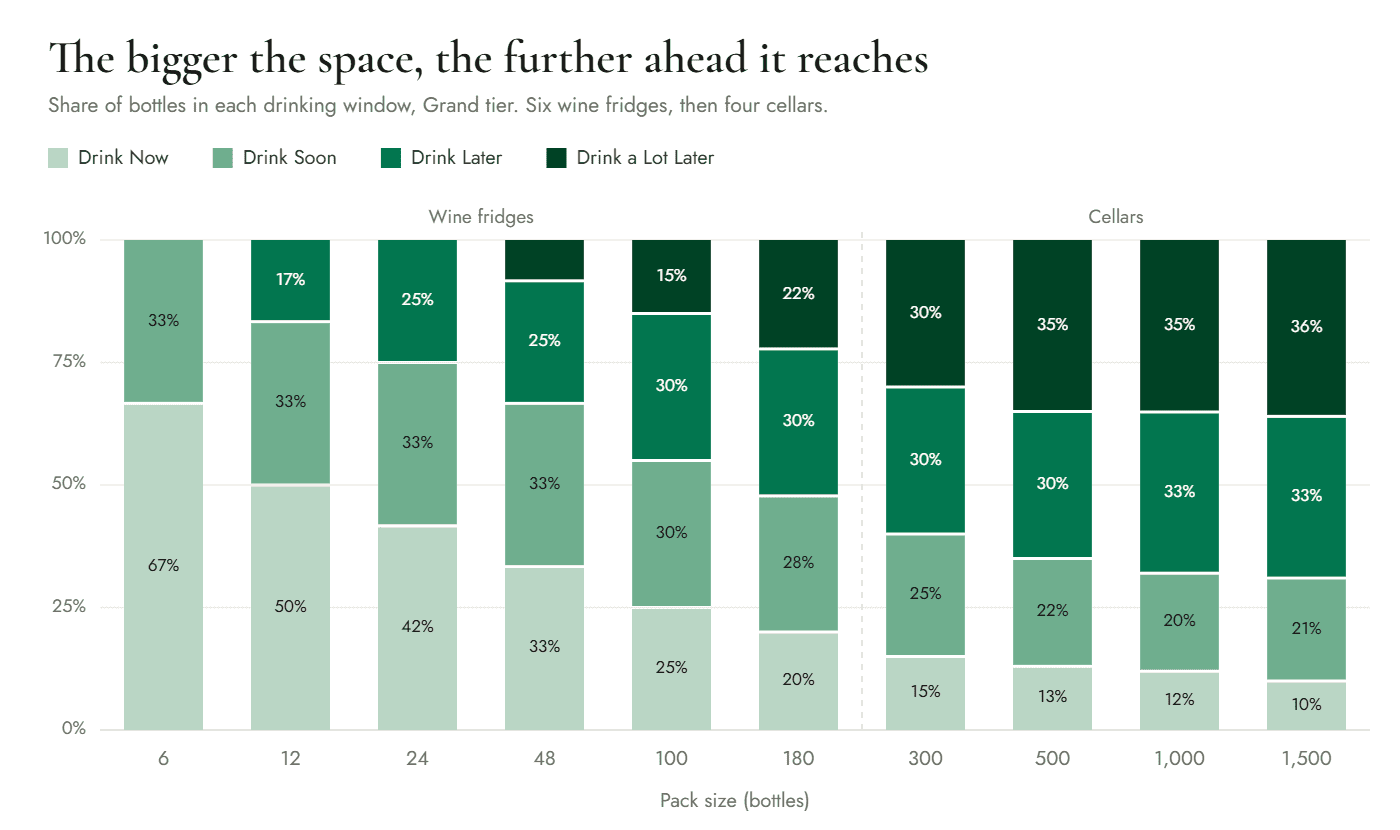
Small fridges get no Drink a Lot Later wine at all. A bottle meant for 2040 should not spend fifteen Adelaide summers in a benchtop unit. Long-term wine starts at 48 bottles, the size where most fridges have a proper storage zone.
Style follows the window
Rosé belongs in Drink Now and nowhere else. Sparkling and white wine thin out as the windows lengthen, because few of them improve past ten years. The exceptions are worth knowing: Clare and Eden Valley Riesling, Hunter Semillon, white Burgundy and the best Champagne. By the Drink a Lot Later window nearly four bottles in five are red, with Sauternes, vintage Port and German Riesling making up much of the rest.
Buy depth where the wait is long
For wine you will open this year, one bottle of each is plenty. Range is the point.
For wine you will open in 2035, buy several. Six bottles of a good Barbaresco let you open one every couple of years and watch it change. Our larger packs buy the long-term wines in sixes and twelves for this reason.
Keep it broad
A cellar built on one grape or one country is dull by the third year. We keep any single variety to about a fifth of the wines in a pack and any single country to under half, and in the smaller packs no producer appears twice. We also lean on wines that are hard to find at a chain: back vintages, grower Champagne, small Burgundy domaines and the Rhône crus.
Match the reach to the budget
This is where the price chart bites. Very few wines under about $70 a bottle will still be improving in 2037, and most of those are Clare and Eden Valley Riesling, Hunter Semillon and Coonawarra Cabernet. Filling a modest cellar with long-term wine would mean buying bottles that fade before their year comes.
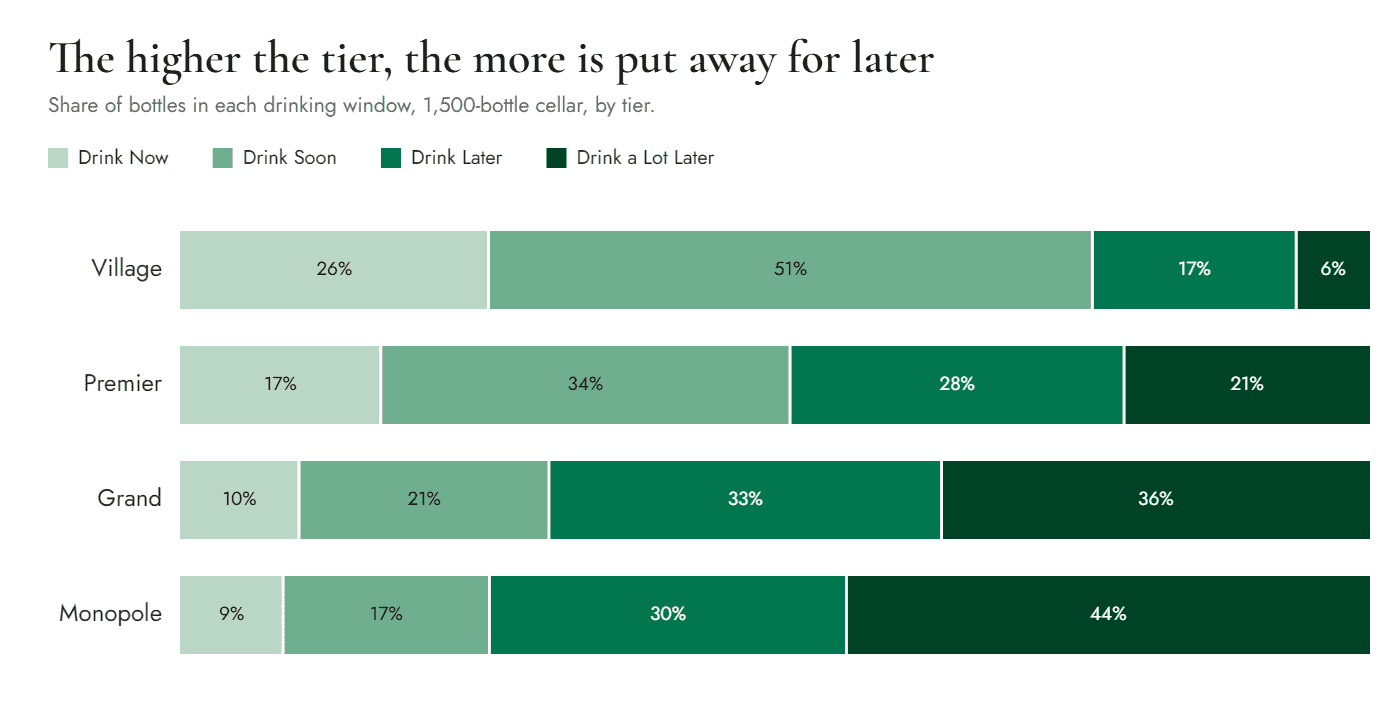
So our four tiers reach to different depths. In a 1,500-bottle cellar, Village holds 6% Drink a Lot Later wine, Premier 21%, Grand 36% and Monopole 44%. The lower tiers put the difference into wine for the next five years, where the value is best.
Keep the ladder full
Dates only help if you can see them. Every bottle in our packs carries a neck tag with its best year, and every pack comes with a drinking plan card that lists what to open this year, next year and beyond.
A ladder also needs topping up at the long end, or in ten years there will be nothing left to wait for. Once a year, buy about a year’s drinking of new Drink Later and Drink a Lot Later wine, and the cellar keeps its shape for as long as you keep it.
Storing wine in Adelaide
- Cool and steady. 13 to 16°C is ideal. Big swings do more harm than a constant 18°C.
- Humid. 50 to 80% humidity stops corks drying out.
- Dark and still. Light and vibration both age wine faster.
- On its side. Lie cork-sealed bottles down. Screwcaps can stand.
- Ready for a heatwave. A wardrobe on an inside wall beats a garage, and a fridge in a hot kitchen works hard in January. If the power goes out, keep the door shut.
For the wines themselves, see our guide to wines for cellaring in Adelaide.
The Cellar Collection. Ten packs, from a six-bottle benchtop fridge to a 1,500-bottle cellar, each in four tiers: Village, Premier, Grand and Monopole. Every bottle arrives tagged with its year. See the packs.
Start your cellar
Browse The Cellar Collection online, or come in and talk it through over a glass at 220 Grenfell Street, Adelaide East End.
How to build a wine cellar: the short version
Buy across drinking windows, store at a steady cool temperature, and keep a list. Plan the space with our wine cellar calculator, or see Septimus Cellar for wines picked to drink in order.