
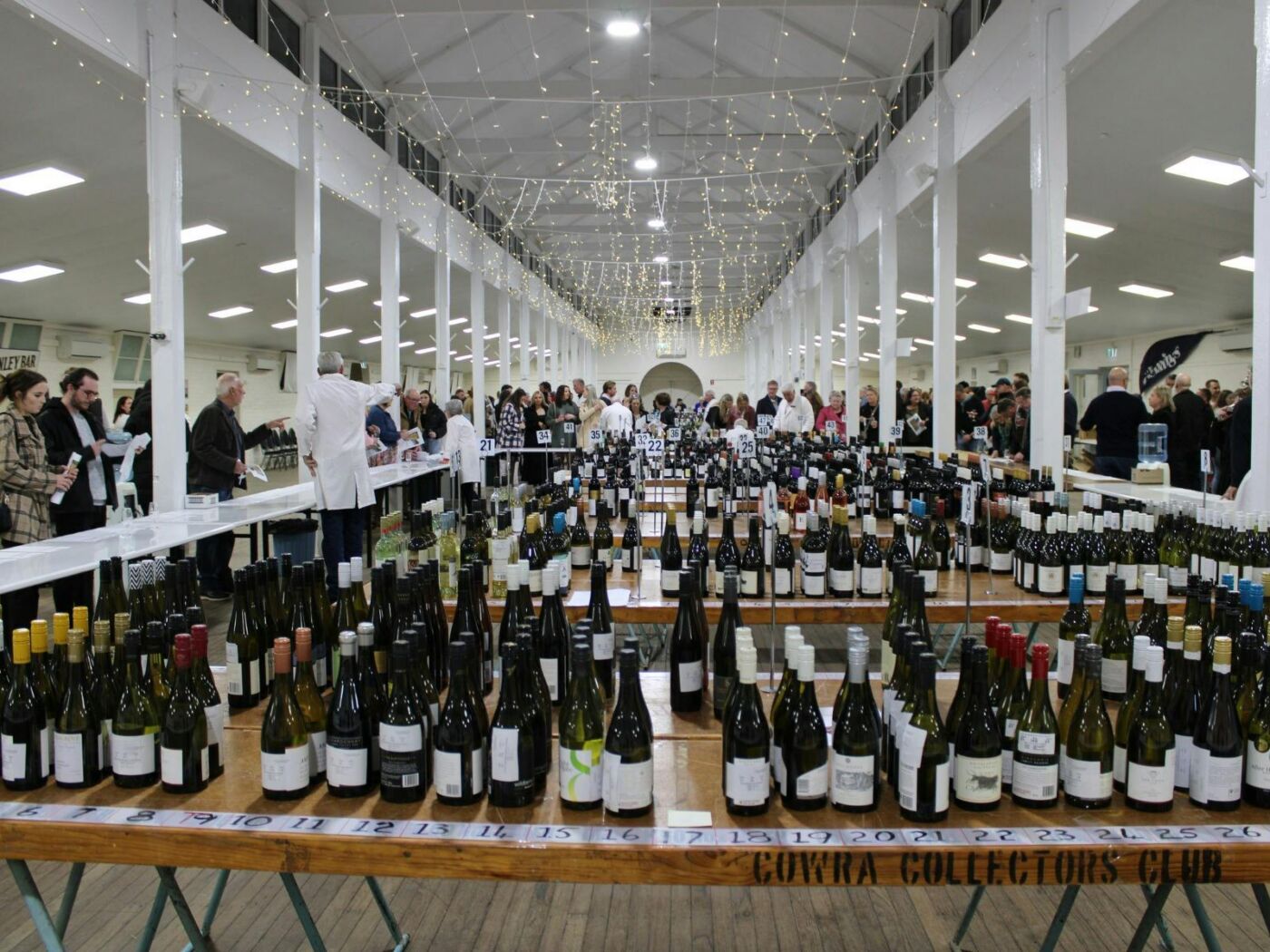
Wine Industry
In brief
- Australia’s wine shows are blind tastings that award medals and trophies. The first recorded wine competition was in 1826.
- They cleaned up technical faults and made medals a sales tool, and were criticised for favouring big, safe styles and a closed circle of judges.
- Reforms since 2001, including the Len Evans Tutorial, judge term limits and ASVO guidelines, have opened them up.
- The next tests are alternative varieties, natural wine and sustainability.
Why the show system matters
The Australian wine show system has shaped the country’s wine more than any critic or law. France and Italy rank quality through appellation rules built up over centuries. In the United States, individual critics carry more weight. In Australia it has been the shows: a national network of blind tastings that check quality, push styles, sell wine and set the industry’s standards. Their influence runs from the vineyard to the price on the shelf.
The shows began as a way for colonial growers, far from any wine tradition, to learn together. Over nearly two centuries they have become sophisticated and much argued about. They are credited with ridding Australian wine of technical faults, and blamed for rewarding safe, similar wines. This piece covers where the system came from, how judging works, who shaped it, what it has done to Australian wine, and where it is heading.
How it started, 1788 to 1949
Two things shaped the system from the start: the colony’s isolation from Europe and the lack of any local winemaking tradition. Australian viticulture started from nothing with the arrival of the First Fleet in 1788.
The Agricultural Society Framework
The Australian wine show system’s structure was inherited directly from the British agricultural show tradition, which was transplanted to the colonies as a means to foster agricultural development, encourage experimentation, and reward excellence. The Agricultural Society of New South Wales, founded in 1822, was the first. Its stated aim was to improve colonial agriculture by offering “suitable rewards and marks of distinction”. As early as 1826, the Society held its first wine competition, offering a small gold medal for the “best sample of Colonial Wine”. This marks the formal beginning of competitive wine assessment in Australia. The earliest surviving record of wine being exhibited at a major capital city show dates to the 1845 Adelaide show, where wines were initially included in a “general produce” section before a dedicated wine show was established decades later in 1971.
Groping in the dark
The early vignerons, predominantly of British heritage, had little to no practical experience in viticulture or oenology. They were, in their own words, “merely groping our way singly in the dark”. The shows became places to learn and compare rather than to protect a tradition. They were a mechanism for creating and disseminating knowledge, establishing baseline quality standards where none existed. That purpose, learning together in isolation, still explains why the shows matter so much here.
Early Specialisation and Collaboration
It was quickly recognised that wine, with its “additional political, moral and production complexities,” required a more focused approach than other agricultural products. This led to the formation of the Hunter River Vineyard Association in 1847, the first specialised wine-focused body in the colony. Arising from local discontent with the broader agricultural society, its objectives were specifically to promote the culture of the vine and its commercial potential. It set a pattern of industry self-organisation and shared learning that lasted.
The progress of these early efforts was soon recognised on the international stage. At the 1873 Vienna Exhibition, French judges, tasting blind, praised wines from Victoria but withdrew their praise in protest when the Australian origin was revealed, on the grounds that wines of such quality must be French. It showed how fast quality had improved, and how much prejudice the colonists faced.
The Inter-War Decline
In the first half of the 20th century the shows lost influence. The disruption of two world wars, the establishment of formal wine research and educational bodies that took over the system’s educational role, and a market shift towards low-priced, bulk fortified wines for export diminished the shows’ relevance. During this period, their primary function was reduced to that of a basic “quality checking mechanism” to ensure consistency for the bulk fortified trade, a long way from their original ambitions.
| Date | Event | Key Figures/Institutions | Significance |
|---|---|---|---|
| 1826 | First recorded wine judging at an agricultural show. | Agricultural Society of NSW | Marks the formal beginning of competitive wine assessment in Australia. |
| 1845 | Earliest surviving record of wine exhibited at a capital city show. | Adelaide Show | Establishes the capital city agricultural show as a key venue for wine exhibition. |
| 1847 | Hunter River Vineyard Association formed. | Hunter Valley Vignerons | First specialised wine body, signalling a move towards industry self-regulation and a focus on viticultural excellence. |
| 1950s | Introduction of the modern medal award system (Gold, Silver, Bronze). | Capital City Shows | Transforms shows from a simple ranking exercise into a powerful promotional tool for a wider range of producers. |
| 1974-76 | Wolf Blass wins the Jimmy Watson Trophy three consecutive times. | Wolf Blass | Linked show success to mass-market sales and brand building. |
| 1986 | ASVO publishes first Australian Wine Show Model Standards. | ASVO | First major step towards codifying standards and professionalising the judging process across the country. |
| 2001 | Len Evans Tutorial (LET) established. | Len Evans | A direct response to criticisms of nepotism; institutionalises the training of a new generation of judges, professionalising the role. |
| 2015/2020 | ASVO publishes revised Best Practice Guidelines. | ASVO | Codifies modern standards for judging, conflicts of interest, and judge rotation, marking the system’s maturation into a more transparent entity. |
The modern era, 1950s to 1990s
After the war, Australians moved from fortified wine to table wine and the shows came back to life. They went from a technical forum to a commercial force.
The Post-War Pivot to Table Wine
The collapse of the lucrative fortified wine export trade to the United Kingdom, coupled with a surge in domestic demand for table wines driven by post-war European migration and rising prosperity, forced the industry to change. The wine show system adapted to meet these new production and marketing challenges, encouraging better table wine and helping to sell it.
Wolf Blass and the Jimmy Watson
The turning point came from one winemaker and one trophy. In the early 1970s, the Jimmy Watson Memorial Trophy, awarded for the best one-year-old dry red at the Royal Melbourne Wine Show, was respected but little known outside the trade. When Wolf Blass won it three years running, from 1974 to 1976, he advertised the wins heavily. That campaign is widely credited with turning the Jimmy Watson from an insider accolade into one of Australia’s most coveted and commercially valuable awards, once quoted as being worth “$1 million in sales”. It made Wolf Blass and the trophy household names, and tied show success to sales in the public mind.
The Medal as a Marketing Tool
The medal system (gold, silver, bronze) added to this. It allowed a much greater number of wines to claim an award, moving beyond a simple first, second, and third-place structure. For shoppers facing a crowded shelf, a medal sticker on a bottle became an “attractive, eye-catching promotional device”, and a seemingly impartial sign of quality. Medals sold wine, and every winery wanted them.
That created a strong incentive for wineries to produce wines that would win medals. This pressure to conform to a perceived “show style” that would appeal to judges, often technically clean, powerful, and fruit-forward, led to later criticism that the system was stifling stylistic diversity and rewarding safe, homogenous wines over more challenging or unique expressions. The tension between technical quality and interesting wine that runs through today’s debates started here.
Driving Technical Improvement
The shows also lifted the technical quality of Australian wine. Far from Europe, they were where winemakers reviewed each other’s work. The post-war emphasis on appointing technically trained winemaker judges to panels mattered most. These judges could readily identify and penalise common wine faults, forcing the industry to solve widespread technical problems. Success in the show ring promoted the emulation of superior techniques; for example, the gold-medal success of an Orlando Riesling in the 1950s helped pioneer the adoption of temperature-controlled fermentation tanks in Australia, an important step. That technical baseline later made the export boom possible.
How wine show judging works
The shows’ credibility rests on a strict judging process built for objectivity and consistency. Inside that process sit some real arguments about what quality is.
Core Principles of Judging
Everything rests on blind tasting. Judges assess wines poured from masked bottles, with no knowledge of the producer, brand, or price, ensuring that evaluations are based solely on the liquid in the glass. The second core principle is judging “like-with-like.” Wines are organised into specific classes based on grape variety, blend, region, and vintage, so that, for example, a young Hunter Valley Semillon is judged against its peers, not against an aged Barossa Shiraz.
The Judging Panel Hierarchy
A major show’s judges are organised in layers, to balance experience, reach agreement and train new judges.
- Chair of Judges: The highest authority at the show. This individual oversees the entire judging process, ensures consistency across all panels, resolves any disputes, and has the final say on trophy awards.
- Panel Chair: Leads a single panel (typically of three to five judges). The Panel Chair guides the tasting process, facilitates discussion, encourages consensus, and provides feedback to the Chair of Judges.
- Senior Judges: These are experienced tasters drawn from a diverse range of industry backgrounds. While panels were once dominated by winemakers, they now regularly include viticulturists, sommeliers, retailers, journalists, and wine educators, bringing a breadth of perspectives to the table.
- Associate Judges: Essentially judges in training, associates taste alongside the senior judges and their scores are recorded and often contribute to the final result. This is the formal pathway for new talent to gain experience, network with industry experts, and build the skills necessary to become a qualified senior judge.
Scores and medals
Australian shows use two scoring scales, and the move from one to the other has been debated.
- The 20-Point System: This is the traditional Australian show scale, where wines are scored for overall quality on a 20-point scale, often with increments of half points. A score of 18.5 or above typically equates to a Gold medal, 17.0 to 18.4 for Silver, and 15.5 to 16.9 for Bronze.
- The 100-Point System: Increasingly adopted by major capital city shows like the Sydney Royal and Royal Queensland, this scale aligns with the language popularised by international wine critics like James Halliday and Robert Parker. It is often perceived as more intuitive for consumers. The typical medal equivalence on this scale is:
- Gold: 95–100 points
- Silver: 90–94 points
- Bronze: 85–89 points.
Supporters of the 100-point scale say it is finer-grained and is more readily understood by the public, while critics suggest it can lead to score inflation and question whether points or medals are a more meaningful indicator of quality for the average consumer.
From individual scores to a panel verdict
Judging follows a set order. Judges on a panel first assess a flight of wines independently and in complete silence to prevent influencing one another. Each judge assigns a score to every wine. After this individual assessment is complete, the Panel Chair leads a discussion where judges may advocate for their scores. Through discussion and potential re-tasting, judges may adjust their scores to achieve a panel consensus, especially for wines on the cusp of a medal or a higher award. If multiple wines in a class receive a Gold medal, a “taste-off” is held to determine the “top gold,” which then becomes eligible to compete for the show’s major trophies at the conclusion of the judging.
The structure has a built-in tension. It starts with each judge’s palate on its own and ends with a negotiated group verdict. The panel’s agreed view wins over any single taster’s insight.
That protects against one judge’s bias. It can also smooth over unusual wines in favour of a safe, technically sound middle ground, which is one of the most common criticisms of the system.
The people and institutions behind it
A handful of people and institutions shaped the system’s standards and culture.
Len Evans (1930 to 2006)
Few people did more for Australian wine culture than Len Evans. Described as the man who did more to “advance the cause of wine in Australia than any other individual,” Evans was a writer, promoter, judge, winemaker and educator. He authored Australia’s first regular wine column in 1962 and helped steer the nation’s taste away from sweet fortifieds towards dry table wines, kick-starting the modern wine boom.
Evans recognised in the 1990s that the show system was at a “crossroads,” stagnating under the control of a closed “cabal of old white men” with little opportunity for new talent. His response was the creation of his most enduring legacy: The Len Evans Tutorial (LET). Founded in 2001, the LET is an elite, week-long, intensive training school for twelve of the country’s most promising wine professionals each year. Scholars taste and dissect hundreds of the world’s greatest wines to hone their skills in identifying quality, refining their vocabulary, and mastering the technicalities of scoring. The effect has been large. LET scholars have gone on to become the chairs of nearly all capital city shows and many regional shows, professionalising the role of the wine judge and reforming how shows are run and how judges are selected.
James Halliday (born 1938)
Often described as Len Evans’s protégé and successor as Australia’s leading wine writer, James Halliday’s influence came through different channels. A lawyer by training and a winemaker by practice (co-founding Brokenwood and founding Coldstream Hills), Halliday’s primary impact comes from his prolific writing, most notably his annual James Halliday Wine Companion.
His adoption and popularisation of the 100-point scoring system gave consumers a simple benchmark for quality that operated in parallel to, but was deeply intertwined with, the formal show system. A high Halliday score could be as commercially valuable as a gold medal. Furthermore, as a highly respected judge and long-serving chairman of Australia’s most important shows, including the National Wine Show, the Adelaide Wine Show, and the Sydney Royal Wine Show, he directly shaped judging standards and outcomes for decades. Being both critic and judge created a feedback loop, driving winemakers to produce wines that would impress both judges and the reading public.
Max Schubert (1915 to 1994)
While not a show system administrator like Evans or Halliday, Max Schubert, Penfolds’ first Chief Winemaker, changed the system’s idea of greatness. His creation, Penfolds Grange, is a story of persistence against the tastes of the time. When the early experimental vintages were presented to the Penfolds board and wine experts in 1957, the wine was “universally disliked” and Schubert was ordered to cease production. One critic famously dismissed it as a “very good, dry port, which no one in their right mind will buy”.
Undeterred, Schubert continued to make Grange in secret for three vintages (1957-1959). As the early vintages aged and showed their complexity, opinions began to change. The 1955 vintage went on to win more than 50 gold medals in competitions starting from 1962. Grange’s success set a new model for Australian fine wine: power, complexity and the ability to age. It pushed judges and critics to look past wines that were merely clean, and became the benchmark for top Australian reds.
Key Institutions
- ASVO (Australian Society of Viticulture and Oenology): The ASVO provides the technical and ethical backbone for the modern show system. Its regularly updated Best Practice Guidelines is the foundational document for show committees, providing clear recommendations on everything from judging procedures and the use of medals to managing conflicts of interest and implementing judge rotation policies.
- AWRI (Australian Wine Research Institute): The AWRI provides the scientific underpinning for wine assessment. Its rigorous Advanced Wine Assessment Course (AWAC) is a key training and evaluation programme for aspiring judges. The course uses statistical evaluation to measure a taster’s performance on key metrics like discrimination (the ability to separate wines of different quality) and reliability (scoring consistency), providing an objective measure of sensory skill.
Together, the LET, the AWAC and the ASVO guidelines have professionalised wine tasting. A closed winemakers’ art is now a skill that is taught and measured. That has made the system more rigorous and credible. However, it also raises a deeper question about whether “taste” can, or should, be standardised. It may also favour judges who excel within this specific, taught framework, potentially marginalising those with different but equally valid palates or philosophies, a concern that echoes in the modern “groupthink” critique of the system’s training grounds.
What the shows did to Australian wine
The shows have lifted quality and, at times, limited creativity. They raised technical standards and also made wines more alike.
Improving the breed
The system’s best-known success is “improving the breed” of Australian wine. The focus on technical assessment by trained judges effectively forced winemakers to identify and eliminate significant winemaking faults. Obsolete descriptors like “sweaty saddle” character (often due to Brettanomyces spoilage) in Hunter reds or “barnyard” notes in McLaren Vale reds, once considered regional traits, were correctly identified as faults and systematically eradicated from Australian winemaking. That lifted the baseline across the industry, which was needed for Australia’s emergence as a major, reliable wine exporter in the 1980s and 90s.
Influence on Winemaking Styles
The shows have also shaped wine styles, more controversially.
- The Rise of “Show Wines”: The competitive nature of judging, particularly in large classes where dozens of wines are tasted in quick succession, tends to favour wines that are immediately impressive and impactful. This has often translated into rewards for wines characterised by power, intense fruit concentration, and the prominent influence of new oak, attributes that stand out in a large lineup. This dynamic can disadvantage wines built on subtlety, elegance, or a structure designed for long-term ageing, which may appear muted or ungenerous in their youth.
- Amplifying Stylistic Trends: The show system does not operate in a stylistic vacuum; it both reflects and amplifies prevailing trends within the judging community. In the 1980s, a common perception among judges was that a “good red would always beat a good white” in trophy judging. By the 1990s, a crisp, high-acid Riesling seemed capable of beating anything. More recently, the co-fermentation of a small amount of Viognier with Shiraz became a fashionable and award-winning style. What wins changes with the judges’ tastes.
- A Shift in Tolerance for “Faults”: Judges have also relaxed about some old faults. There is now greater tolerance, and sometimes even reward, for minor characteristics that might have been penalised as faults a decade ago but are now seen as adding complexity. A prime example is the slight sulphidic, “struck match” character in some modern Chardonnays, which is now often considered a positive attribute adding a savoury, flinty dimension. This reflects a broader industry shift towards less-interventionist winemaking and an appreciation for wines with more texture and personality.
Commercial Value and Marketing Power
The shows carry real commercial weight.
- Price Premiums and Market Influence: Hedonic price analysis has shown that wine show medals, particularly from the most prestigious shows, are correlated with statistically significant price premiums for the winning wines. A high score or a trophy from a major show is strong market validation that wineries can leverage for higher prices.
- Consumer Guidance and Trust: For the average consumer, awards are a useful shortcut in a crowded market. They offer what is perceived as an impartial, expert evaluation that helps guide purchasing decisions and signals a certain level of quality and value. A bottle adorned with a medal sticker is demonstrably more likely to be purchased than one without, making show success a direct driver of retail sales.
- The Need for Integrity: Because awards are worth so much, rules now protect their integrity. The ASVO guidelines explicitly aim to prevent the exploitation of the system, such as the use of misleading, medal-like devices on labels or the fraudulent application of a medal won by one vintage or blend to a subsequent, different wine.
In a country like Australia, which lacks a legally enforced, hierarchical appellation system that classifies vineyards or producers in the style of Burgundy’s Grand Crus, the wine show system has evolved to fill this void. It functions as a de facto, merit-based classification system. While not tied to terroir, a winery’s consistent record of success at major shows over many years becomes a proxy for its status and quality. This cumulative “track record” shapes its reputation, pricing power, and standing within the industry, Australia’s answer to signalling quality without an appellation system.
Criticism and reform
The shows have always had critics, and criticism has led to reform.
A closed circle
The harshest criticism was of its culture in the late 20th century. During this period, it was widely perceived, both internally and externally, as a “cabal of old white men”. The judging circuit was dominated by a small, insular group of winemakers, typically from large companies, who controlled judging appointments and, by extension, the outcomes of the shows. It was common for judges to hold their positions for many years, even decades, with little opportunity for “fresh blood” to enter the system. The panels lacked diversity almost entirely; there were virtually no women, sommeliers, wine traders, or journalists involved in the judging process. Outsiders, new regions and new styles found it hard to break in.
Criticism today
Access has improved. Today’s criticism is about how the shows judge.
- Stylistic Conservatism: A persistent criticism is that judges are inherently conservative. New or different styles, wines from obscure grape varieties, and particularly wines built for long-term ageing that may be structurally austere in their youth, are often said to be handicapped in a system that can favour immediate appeal.
- Inconsistency of Results: The credibility of the system is sometimes undermined when a wine is awarded a gold medal at one show and a mere bronze at another just weeks later. This inconsistency is often attributed to the subjective nature of taste, differing stylistic preferences among judging panels, and the significant impact of palate fatigue.
- Palate Fatigue and the “Big Thumper” Problem: In major shows, some classes can be enormous, with judges asked to assess upwards of 85 young Shiraz entries in a single session. Under these demanding conditions, the palate can become fatigued, making it difficult to appreciate subtlety. There is a real risk that fine, elegant wines can be passed over when judged immediately following a series of powerful, high-alcohol, “big thumper” wines that dominate the senses.
- Marketing Over Merit: A growing concern is that the primary purpose of wine shows may be shifting away from the traditional goal of “improving the breed” and towards functioning purely as a marketing tool for the industry. If this is the case, the emphasis on rigorous, objective judging could become secondary to creating a good story for marketing departments, potentially devaluing the awards themselves.
- The “LET Groupthink” Critique: A newer criticism targets the institution built to reform the system: the Len Evans Tutorial. The LET has improved the quality and professionalism of judging. But its exclusivity (only 12 scholars per year) and the close-knit nature of its alumni network have led to concerns about a new form of elitism. Critics suggest that with a small group of influential tutors and a consistent curriculum, there is a risk of creating a “groupthink approach to wine judging,” which could inadvertently reinforce existing industry networks and limit the diversity of perspectives at the highest levels.
How the system changed
Over the past two decades the system has changed a lot.
- Judge Rotation Policies: Term limits for judges have made a big difference. At many capital city shows, such as the Royal Brisbane Wine Show, chairs, panel chairs, and judges serve for a maximum of three years, ensuring the entire judging panel is turned over regularly. This policy creates constant opportunities for new talent and prevents the entrenchment of any single palate or preference.
- Increased Diversity of Panels: Shows have deliberately diversified judging panels beyond winemakers. The inclusion of sommeliers, retailers, educators, and journalists brings a wider range of perspectives, palates, and commercial realities to the judging table.
- Formalised Standards and Training: The widespread adoption of the ASVO Best Practice Guidelines has introduced a new level of professionalism, transparency, and ethical conduct, particularly around managing conflicts of interest. Concurrently, the institutionalisation of judge training through programmes like the LET and the AWRI’s AWAC has shifted the pathway to becoming a judge from an informal apprenticeship model to a more structured, merit-based system.
The reforms have changed the debate. The initial, and most biting, critiques were about fairness and access, the fight against a closed “cabal.” The reforms have largely addressed these structural problems. As a result, the contemporary debate is no longer primarily about who gets to judge; it is about how they should judge. The conflict between a sommelier’s focus on fashion and a winemaker’s emphasis on technical purity is a philosophical one. The argument over whether to reward “interesting faults” is also a matter of philosophy. The argument has moved from nepotism to a harder question: what quality means now.
How Australia compares
No other major wine country leans on its shows the way Australia does. History, geography and the shows’ role in building the industry explain why.
Centrality to the Domestic Market
For over 150 years, the show system has served as the primary national mechanism for education, quality benchmarking, and promotion. Australia is a vast continent with its wine regions separated by long distances. Historically, the capital city shows were one of the few opportunities for winemakers from disparate regions like the Hunter Valley, the Barossa Valley, and Margaret River to come together, taste each other’s wines, share knowledge, and collectively gauge the progress of the industry. That built a shared national standard. In contrast, the dense, interconnected wine regions of Europe had different mechanisms for knowledge transfer and quality control.
Australian shows and the Decanter World Wine Awards
Comparing them with the Decanter World Wine Awards (DWWA) shows what is different.
- Scale and Philosophy: The DWWA is a massive, global competition, assessing over 18,000 wines from nearly 60 countries in a single event. Its primary purpose is to provide international benchmarks and guide consumers and trade buyers around the world. Australian capital city shows, while large, are national events focused on assessing the domestic vintage and rewarding excellence within the Australian context.
- Sphere of Influence: A top award at the DWWA, such as a “Best in Show,” is strong international validation and is a key marketing tool for breaking into or succeeding in export markets. Conversely, winning a major Australian trophy, like the Jimmy Watson, holds immense power and prestige within the Australian domestic market, capable of shaping a brand’s reputation and sales for years to come.
- Performance as Validation: The consistent and outstanding performance of Australian wines at international competitions like the DWWA can be seen as a direct validation of the high technical standards fostered by the rigorous domestic show system. Australia regularly wins a disproportionately high share of top awards. In the 2024 DWWA, Australia won eight “Best in Show” awards, second only to France, a country with a much larger production volume. That success supports the credibility of judging at home.
- Judging Perspectives and the “Insularity” Debate: A key point of difference and debate is the composition of the judging pools. The Australian system has been criticised for being insular, leading to calls for the inclusion of more international judges to bring different perspectives on style, quality, and global trends. Proponents of this view argue that overseas judges provide a valuable external lens and prevent the development of a purely domestic “show style” that may be out of step with international markets. Others argue that Australian judges have unmatched technical skill and local knowledge, and that the system is best served by domestic experts who deeply understand the nuances of Australian terroir and winemaking.
The two feed each other. The domestic shows lift quality, which helps Australian wines win abroad, which in turn backs the domestic shows. International tastes also push back on any home-grown show style.
What comes next
The shows have shown they can reform. Three trends will test them next: the rise of alternative grape varieties, the philosophical challenge of “natural” wine, and the non-negotiable imperative of environmental sustainability.
The Rise of Alternative Varieties
With the climate changing, more growers are planting alternative grape varieties, those outside the mainstream of Shiraz, Cabernet, Chardonnay, and Sauvignon Blanc, that are better suited to warmer and drier conditions. This has led to the creation of specialised forums dedicated to assessing these emerging wines. The most prominent of these is the Australian Alternative Varieties Wine Show (AAVWS), founded in Mildura.
The AAVWS benchmarks varieties like Fiano, Nero d’Avola, Vermentino, and Grüner Veltliner, as well as for emerging styles like Pétillant Naturel (“Pét-Nat”) sparkling wines. By creating specific classes for dozens of these varieties, the show allows them to be judged on their own merits, against their peers, rather than being lost in miscellaneous “other blends” classes at traditional capital city shows. It gives producers trying new things a path to recognition.
Natural wine
Natural, minimal-intervention wine is a harder problem. Natural wines often embrace characteristics, such as elevated levels of volatile acidity, microbial complexity from wild ferments, or a lack of fining and filtration, that would be heavily penalised as technical faults in a conventional judging context. A system built to reward clean wine struggles to judge them on their own terms. The shows will need new criteria that judge these wines on character and drinkability as well as technique. The recent shift to tolerate some “interesting faults,” such as reduction in Chardonnay, is a first step.
Sustainability
Sustainability is now central to the industry’s strategy, pushed by climate change and export markets. Wine Australia has developed a comprehensive Emissions Reduction Roadmap, which targets a 42% reduction in greenhouse gas emissions across the value chain by 2030.
Shows are starting to recognise it. A leading example is the International Cool Climate Wine Show (ICCWS), which has introduced a specific “Excellence in Environmental Sustainability Award.” This award is judged on the winery’s demonstrated commitment to sustainable farming, waste reduction, and carbon footprint reduction rather than on the wine in the glass. Such criteria may become more common, perhaps as a prerequisite for entry or as a component of the overall judging score. That would widen “quality” to include how a wine is made as well as how it tastes.
The shows are organised around grape varieties, and the AAVWS simply adds more of them. Natural wine and sustainability are about philosophy instead. A natural Riesling and a conventional Riesling are good in different ways, and a wine from a carbon-neutral winery in light glass differs from one in a heavy bottle. To stay relevant, the shows will need classes and awards that recognise those differences.
Where it stands
The Australian wine show system began as a way for colonial growers to learn together. Nearly two centuries on, it has shaped the technical quality, style and sales of Australian wine, and given the industry its main forum for debate and benchmarking.
It has earned its criticism, particularly for insularity and conservatism, and it has reformed: it is more transparent, more diverse and more professional.
Its next test is a broader idea of quality that takes in alternative varieties, natural wine and sustainability. If the shows keep adapting as they have before, they will stay at the centre of how Australian wine is judged.
Taste the results for yourself
Trophy winners and quiet achievers alike fill our list. Explore South Australian and French wines by the glass, matched with artisan cheese and charcuterie at our wine bar in Adelaide’s East End.
Come and taste it
Bar Septimus pours French and Australian wine by the glass alongside artisan cheese and charcuterie at 220 Grenfell Street, Adelaide East End.