
Adelaide Food & Wine
The weeks before Christmas are when the Champagne comes out. The labels can still read like a page of French code. This guide to Champagne in Adelaide explains the words that matter, using the thirteen Champagnes on our list at 220 Grenfell Street as examples.
Champagne in Adelaide: start with the sweetness word
Every Champagne label carries a word that tells you how sweet the wine is. Producers set the level through the dosage. These are the bands, in grams of sugar per litre:
- Brut nature or zero dosage: under 3 grams
- Extra brut: 0 to 6 grams
- Brut: under 12 grams
- Extra dry: 12 to 17 grams
- Sec: 17 to 32 grams
- Demi-sec: 32 to 50 grams
- Doux: over 50 grams
Brut is by far the most popular style, according to Decanter, and most non-vintage Champagne sits between 6 and 12 grams. Extra dry is sweeter than brut, despite the name.
Two Champagnes on our list are extra brut: Guiborat’s Tethys.21 and Prisme.19, both grand cru. Order one of those if you like your wine bone dry. Most of the rest are labelled brut.
Blanc de blancs and blanc de noirs
Blanc de blancs means white from whites. It is made only from white grapes, which in Champagne usually means Chardonnay. These wines tend toward lemon and apple flavours. Blanc de noirs means white from blacks: a white Champagne made from Pinot Noir, Pinot Meunier or both.
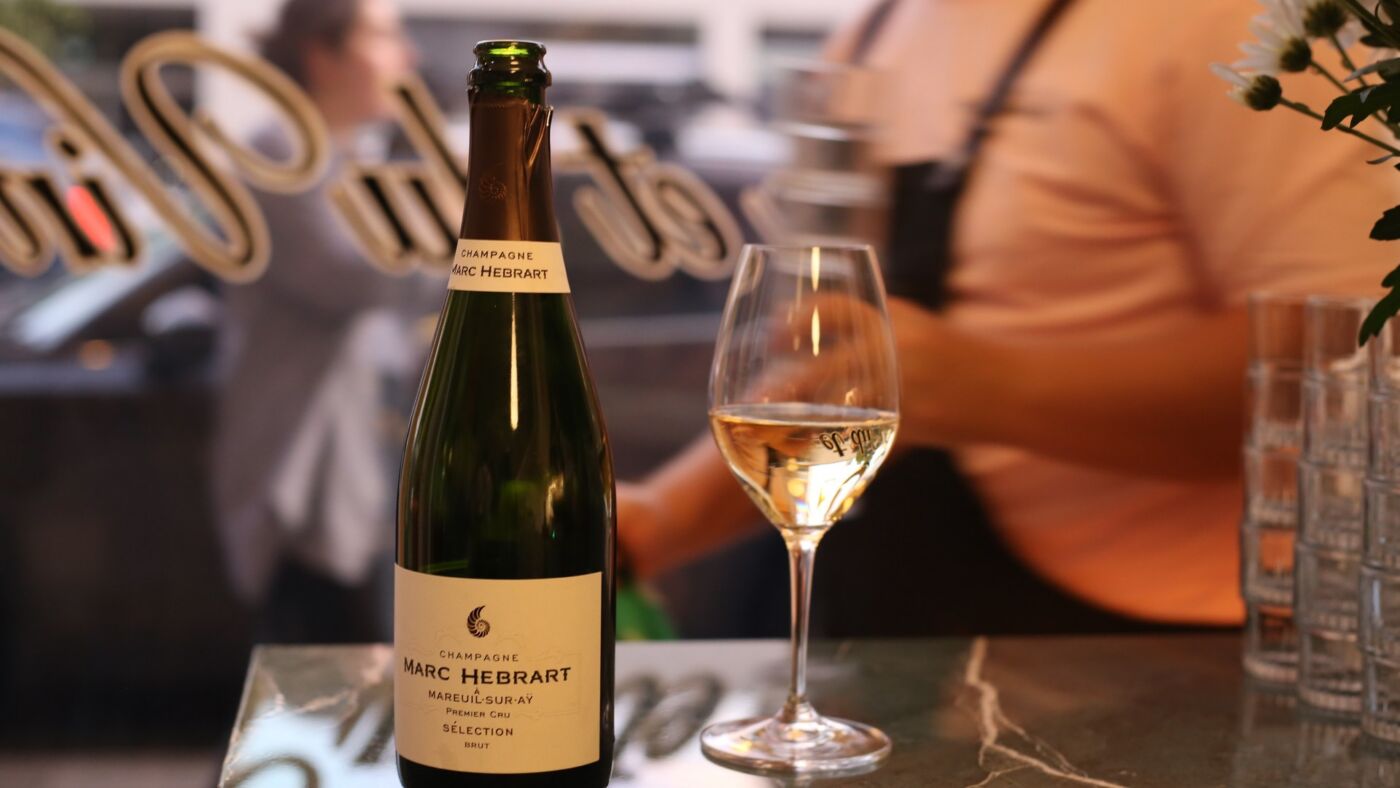
The list carries two blanc de blancs: Pierre Gimonnet’s Cuis 1er Cru and Marc Hébrart’s 1er Cru. For a South Australian comparison, the sparkling section carries the 2022 Piccadilly Circus Blanc de Blancs from the Piccadilly Valley. Open a bottle of each side by side and the difference in place shows quickly.
Grand cru, premier cru and the year on the label
In Champagne, the cru rating belongs to the village. There are hundreds of villages in the region. Only 17 have grand cru vineyards and 42 have premier cru vineyards, as Wine Folly sets out. Grand Cru or 1er Cru on a label tells you where the grapes grew.
Some producers name the village as well. Lafalise-Froissart’s Verzenay Grand Cru Brut carries its village in the title, and Pierre Gimonnet’s blanc de blancs names Cuis.
Vintage and non-vintage
Most Champagne carries no year. Non-vintage wine blends several harvests so a producer can keep a consistent style, and it must age for at least 15 months. Vintage Champagne comes from a single good year and must age for at least three years, and many are kept for seven to ten.
Our one vintage Champagne is the 2019 Marc Hébrart Special Club 1er Cru. The rest of the list is non-vintage.
Grower or house
A grower farms their own vines and makes wine from them, often from a single village. A house buys fruit from across the region and blends for a consistent style from year to year. The small print on the label tells you which:
- RM (récoltant manipulant): a grower-producer using at least 95% estate fruit
- NM (négociant manipulant): a producer that buys in grapes or base wines
- CM (coopérative manipulant): a growers’ co-operative selling under one brand
Our list runs both ways. Taittinger Brut Réserve comes from one of the large houses of Reims. Lafalise-Froissart and Pierre Gimonnet are growers.
What to order with Champagne at the bar
Acidity and bubbles cut through rich, creamy cheese, so soft white-rind cheeses are the classic match. A Demi board brings three cheeses and one seasonal accompaniment for $45. A Magnum board brings five cheeses and two accompaniments for $80. The full list of boards and bottles is on our menu.
For a group, order two bottles in different styles and compare them: an extra brut against a brut, or a grower blanc de blancs against a house blend. Our World Champagne Day post shows how a three-glass comparison works with cheese.
Booking before Christmas
We are open Monday and Thursday from 4pm, Friday from 3pm, and Saturday and Sunday from noon. Book a table online for Friday and Saturday evenings. The upstairs lounge seats about 20 for a group; our end of year function guide explains how to book it.
If you drink pink, the Septimus Rosé Party runs from 2pm to 7pm on Sunday 29 November. Alana Kaye of The Wine Wench hosts seven rosés from South Australia and France, with grazing food, for $85.
Sources
- Chris Wilson, “What does ‘Brut’ mean on a Champagne label? Ask Decanter”, Decanter, updated 15 July 2021.
- Madeline Puckette, “How to Choose Champagne”, Wine Folly, updated 22 December 2025.
- Bar Septimus, menu and events pages, septimus.au, viewed 17 November 2026.
Book a table at Bar Septimus
Bar Septimus is at 220 Grenfell Street in Adelaide’s East End, with French and Australian wine by the glass and artisan cheese and charcuterie.