
Adelaide Wine Guide | Reading Time: 12 Minutes
The French Connection: A Guide to Adelaide’s ‘Old World’ Wine & Dining
Why South Australia is the best place to explore French wine in Adelaide, the last stronghold of pre-phylloxera vines, and why the marriage of cheese and wine is a history lesson you can taste.
Did you know that some of the oldest ‘French’ vines in the world aren’t in Bordeaux, Burgundy or the Rhône Valley, but right here in South Australia?
When you drink a glass of premium South Australian red, you are often tasting a living history that even modern France has lost. In the mid-19th century, a microscopic aphid known as phylloxera vastatrix (the “dry leaf devastator”) inadvertently hitched a ride on steamboats from North America to Europe. The result was catastrophic.
Between 1863 and 1890, this pest decimated over 40% of French vineyards, destroying nearly 6 million acres of ancient heritage vines. The industry was on its knees. To save French wine from extinction, vignerons were forced to take drastic action: they pulled up their centuries-old vines and grafted European cuttings onto resistant American rootstocks. Today, almost every vine in France is a “Frankenstein” plant, a French top grafted onto American roots.
But South Australia was different. Thanks to our geographic isolation and the strict quarantine laws established in the Vine Protection Act of 1874, our state remained a phylloxera-free sanctuary. We are one of the few places left on earth with “own-rooted” vines dating back to the 1840s.
That means when you enjoy a Shiraz or Cabernet from our oldest Barossa or McLaren Vale blocks, you are tasting the original French genetic material in its purest, pre-industrial form. This is the closest you can get to tasting the wine that Napoleon or Louis XIV might have drunk. At Septimus, our wine bar in Adelaide’s East End, we celebrate this living history in every glass.
The Art of L’Apéro: Enjoying French Wine in Adelaide
In France, the most important ritual of the day isn’t always the three-course dinner. It is L’Apéro (short for Apéritif). Derived from the Latin verb aperire, which means “to open,” the purpose of the drink is literally to “open” the stomach and the palate for the evening ahead.
The apéritif is the sacred transition boundary between the stresses of the working day and the relaxation of the evening. It sidesteps heavy courses, white tablecloths and the commitment of a full meal. It is about conversation, fromage, and excellent wine to whet the appetite. In Adelaide’s East End, we have adopted this culture wholeheartedly.
The 3 Rules of L’Apéro at Septimus
Master the French art of the early evening drink:
- The Timing: Ideally enjoyed between 5:00 PM and 7:00 PM. It is the “golden hour” of the evening, too late for coffee but too early for a heavy steak.
- The Drink: The rule of thumb is “dry and high acid.” Avoid heavy, oaky wines that fatigue the palate. Think Champagne, a mineral-driven Chablis, a dry Riesling, or a lighter chilled red (like a Grenache or Gamay). The goal is to stimulate salivation and hunger.
- The Snack: Never a full meal. It requires high-quality finger food, artisanal cheese, charcuterie, and olives. The food exists to support the wine, not dominate it.
Start your evening with us
Pull up a seat for L’Apéro at our East End wine bar. French and South Australian wines by the glass, matched with artisan cheese and charcuterie.
The Sacred Marriage: Why Wine and Cheese Belong Together
At Septimus, we are often asked why wine and cheese are considered culturally inseparable. The answer lies in a blend of 1,000 years of history and modern molecular science.
1. The Historical “Terroir”
In France, the concept of terroir (the taste of the place) applies to milk just as much as it applies to grapes. Historically, before refrigeration and transport, regional winemakers and cheesemakers worked side-by-side. The cows and goats grazed on the same hillsides where the vines grew.
This created the old adage: “What grows together, goes together.”
It is no accident that the acidic, sharp Goat Cheeses (Chèvre) of the Loire Valley pair perfectly with the acidic, crisp Sauvignon Blanc (Sancerre) of the same region. It is not a coincidence that the pungent, salty Époisses cheese was developed in Burgundy, where the bold Pinot Noirs and Chardonnays have the backbone to stand up to it. The French palate evolved to balance the local produce perfectly.
2. The Science on Your Palate
Why does cheese make wine taste better? It comes down to the interaction between proteins, fats, and tannins.
Red wines, especially young ones, contain tannins, phenolic compounds from grape skins and seeds that dry out your mouth and can taste astringent or bitter. Cheese is high in protein and fat. When you take a bite of cheese, the proteins bind to the tannins in the wine, effectively “scrubbing” them away.
This chemical reaction smooths out the wine, making it taste fruitier, softer, and more complex. Conversely, the acidity in the wine cuts through the creaminess of the cheese, cleansing the palate so the next bite feels just as rich as the first. It is a perfect, self-perpetuating cycle of sensory pleasure.
A Tale of Two Terroirs: French Wine in Adelaide vs. The Originals
We pour the legends of France alongside their South Australian descendants so you can taste the difference side-by-side. Here are the four key battles on our menu, ordered by intensity:
1. Champagne vs. Sparkling
The ultimate celebration starter.
- The French Way (Champagne): Strictly from the Champagne region in northern France, these wines are defined by their chalky soil. They offer notes of brioche, toast, citrus, and a distinct minerality. The high pressure and long lees aging create a fine, persistent bead.
- The Adelaide Way (Sparkling): We produce world-class sparkling in the Adelaide Hills using the exact same Méthode Traditionnelle (bottle fermentation). The cool climate of the Hills preserves the acidity needed for premium bubbles. However, for a uniquely Australian twist, try our Sparkling Shiraz, a tradition born in the 1880s that pairs strangely but beautifully with breakfast or dark chocolate.
2. Chablis & Chardonnay
For white wine lovers, the comparison is stark and beautiful.
- The French Way (Chablis): Chablis is Chardonnay, but not as you know it. Grown on ancient Kimmeridgian clay (full of fossilised oyster shells), it is rarely aged in new oak. It tastes of green apple, wet stone, lemon zest, and the sea. It is lean, sharp, and precise.
- The Adelaide Way (Adelaide Hills): While our modern Chardonnay is elegant and restrained, it brings more sun-ripened fruit character. Expect white peach, nectarine, and a touch of creaminess (from malolactic fermentation) that the stricter French Chablis lacks. It is generous where Chablis is austere.
3. Syrah vs. Shiraz
They are the same grape, but two very different stories told by the soil.
- The French Way (Syrah): Often from the Northern Rhône (like Hermitage or Côte-Rôtie). These wines are grown on steep granite slopes. They are savoury, elegant, and driven by “cool” notes of white pepper, violet, olive tapenade, and smoked meat.
- The Adelaide Way (Shiraz): Grown in our warmer, sun-drenched climate, the grape transforms. The skins thicken, sugar levels rise, and the wine becomes bolder, richer, and more fruit-forward. Expect blackberry jam, dark chocolate, liquorice, and sweet spice. At Septimus, we pour both so you can experience the diversity of French wine in Adelaide side-by-side.
4. Bordeaux vs. Coonawarra Cabernet
Two regions famous for their unique red soils and structured longevity.
- The French Way (Bordeaux): The ancestral home of Cabernet Sauvignon. Left Bank Bordeaux is tannic, herbal, and austere in its youth. It is built for decades of aging, often smelling of graphite (pencil lead), cassis, and cedar wood.
- The Adelaide Way (Coonawarra): South Australia’s famous “Terra Rossa” strip (red clay over limestone) produces a bolder, mintier style. It has the firm tannin structure of France but with a uniquely Australian eucalyptus or menthol edge. Read our full guide to Coonawarra Cabernet Sauvignon here.
The Guide: Best Food & French Wine in Adelaide
We know what we do best: Wine, cheese, and intimate conversation. But when you are ready for the full grand-mère style feast, we love our neighbours who bring the heavy classics.
Use this guide to plan your night: Start with us for L’Apéro, then head to:
| Restaurant | Vibe & Atmosphere | Septimus Pro Tip |
|---|---|---|
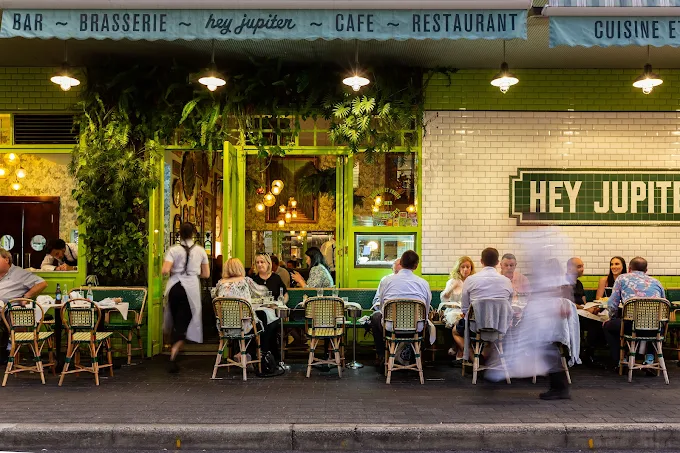
| Hey Jupiter (East End) |
The complete Brasserie experience. With its tiled floors, rattan chairs, and waistcoated waiters, it is bustling, noisy, and authentically Parisian. It feels like a teleporter to Saint-Germain. | Order the Steak Frites. It is the benchmark. The steak is always cooked saignant (rare) as requested, and it comes with possibly the best tarragon Béarnaise sauce in the city. |
| Maison Clément (Currie St) |
The classic “Bouillon” style: fast, affordable, and deeply traditional. It lacks the polish of Jupiter but makes up for it with heart and speed. A favourite for lunch. | Value Pick. Their ‘Menu Fixe’ is incredible value. Don’t skip the Escargots in garlic butter, they are the real deal, complete with dipping bread. |
| Garçon Bleu (Sofitel) |
Gastronomy with a view. Located high up in the Sofitel, this is modern fine dining. The room is stunning, open, and flooded with light. | Date Night. Ask for a window table. Their soufflé is technically perfect, rising high and staying light. A rare find in Adelaide. |
| La Louisiane (King William St) |
The Late Night. Sultry jazz club meets French Brasserie. It is dark, moody, and loud in the best way. Live music sets the tone. | The Vibe. Go here after dinner for Oysters and a Martini, or the Boeuf Bourguignon if you are eating late. |
Planning to bring a special bottle to any of these? Check each venue’s corkage policy in our Adelaide corkage and BYO guide.
Frequently Asked Questions about French Wine in Adelaide
Where is the best place for French wine in Adelaide?
Adelaide has a thriving scene for Francophiles. For a dedicated French wine in Adelaide experience focused on discovery and education, Septimus in the East End offers a curated selection of French varietals (Chablis, Rhône Syrah, Champagne) poured alongside their South Australian counterparts. For a full sit-down French dinner with an extensive cellar list, we highly recommend Hey Jupiter (East End) or the cellar at 2KW for high-end burgundies.
What is the difference between French Syrah and Australian Shiraz?
While they are genetically the exact same grape variety, the names indicate the style of the wine. ‘Syrah’ typically refers to the French style (grown in cooler climates), which is savoury, spicy, medium-bodied, and elegant. ‘Shiraz’ refers to the Australian style (grown in warmer climates), which is bolder, fruit-forward, higher in alcohol, and fuller-bodied. At Septimus, we pour both so you can taste the difference.
Does Septimus serve French food?
Septimus specialises in ‘L’Apéro’ style dining rather than heavy main courses. Our menu features high-quality artisan cheeses (Comte, Roquefort, Triple Cream Brie), cured charcuterie, and small plates designed specifically to pair with wine. We are the perfect pre-dinner destination for French wine in Adelaide before heading to a full-service French restaurant.
About the Author
The Septimus Wine Team
Our team is dedicated to exploring the connection between Old World traditions and New World innovation. We specialise in sensory analysis, blind tastings, and curating the most interesting list of French wine in Adelaide. We believe wine is a conversation, not a lecture. Have a question about a vintage or a cheese pairing? Ask us at the bar.